


Search News
Industry Portal
Popular Tags
All categories
How to verify compliance with green construction materials standards




Compliance with green construction materials standards is established by matching a defined product and application against specific requirements, then examining evidence that covers the same product, production site and assessment period. A certificate, environmental product declaration or laboratory report can support that decision, but none automatically establishes every aspect of compliance.
Start with the exact material specification: product designation, composition or grade, intended use, delivery location and applicable project criteria. Record each required environmental and technical claim separately. A low embodied carbon limit, a recycled content threshold and a strength requirement involve different evidence and may have different acceptance rules.
Translate the specification into verifiable claims
The phrase “green material” has no single universal technical meaning. A project may require conformity with a building rating scheme, a public procurement criterion, a product standard or a contractual environmental limit. The requirements can overlap without being interchangeable. Identify the edition of each referenced document, any local implementation and whether the requirement applies at product, building or project level.
Convert each requirement into a statement that can be tested. For example, “cement with reduced environmental impact” needs a defined metric, reference unit, life-cycle boundary and acceptance limit before it can be assessed. “Recycled content” needs a definition of eligible material, a calculation basis and a rule for allocating shared inputs. Where the specification refers to a third-party label, identify the applicable product category and the particular criteria the label covers.
Separate mandatory conditions from optional credits. A material may qualify for a building assessment credit while still requiring independent evidence of structural performance or emissions compliance. Conversely, a product that meets a technical standard does not automatically satisfy an environmental threshold.
Establish that the documents describe the supplied material
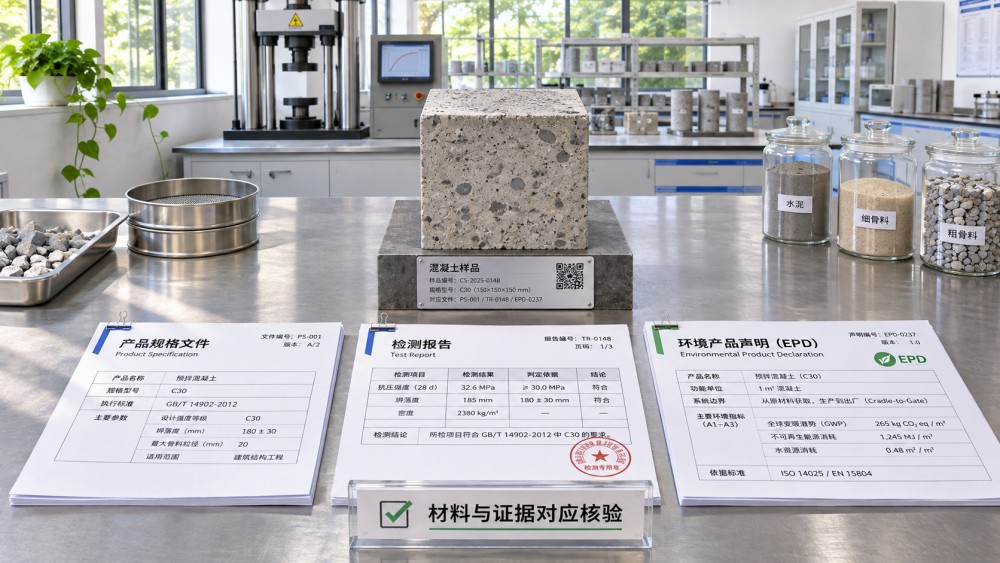
Traceability is the connection between an environmental claim and a delivery. Compare the product name, grade, formulation or composition range, plant address and manufacturer identity across the specification, declaration, certificate, test report and order documents. Differences are not automatically disqualifying, but they require an explanation supported by the issuing organization or technical documentation.
Pay particular attention to product families. A certificate may cover several thicknesses or grades under a defined scope; a test report may cover only the samples submitted. A generic certificate for a company’s management system does not demonstrate that a particular glass panel, cement blend or AAC block meets a product-level environmental criterion. Similarly, a declaration covering an industry average is not evidence of a particular plant’s performance unless the project permits that type of data.
Record document identifiers, issue and expiry dates where applicable, the issuing or verification body and the scope of verification. Confirm certification status through the issuer’s current public directory or directly with the issuer when a directory is unavailable. An expiry date alone is not enough: the certificate must also cover the product, location and relevant activity. If a document has been superseded, establish which version applies to the assessment and whether the delivered material remains within its scope.
Read an environmental product declaration in context
An environmental product declaration, or EPD, reports quantified environmental information based on life-cycle assessment rules. It is not, by itself, proof that the product is environmentally preferable or that it passes a project limit. First establish whether the project accepts that EPD type and whether the declaration is current and independently verified where required.
The declared or functional unit determines what the figures represent. One tonne of cement, one cubic metre of AAC blocks and one square metre of glass are different bases. Even two figures expressed per square metre can describe different thicknesses, coating systems or design lives. Normalize only when the conversion is technically justified and retains the relevant performance conditions.
Then inspect the system boundary. A manufacturing-stage result does not include the same activities as a result that also covers transport, installation, maintenance or end-of-life treatment. Life-cycle modules reported separately should remain separate unless the governing rules allow aggregation. Benefits reported beyond the product system boundary should not be silently subtracted from the product’s stated emissions.
Comparisons require compatible product category rules, calculation methods, impact indicators and data quality. Allocation of energy and emissions among co-products can also change results. If declarations use different rules or cover different life-cycle stages, request aligned data rather than ranking products by the headline number.
Account for the installed quantity
A lower impact per tonne does not necessarily produce a lower impact for the completed element. A change in cement composition, block density or glass configuration may alter the quantity needed to meet strength, thermal, acoustic or durability requirements. Compare equivalent design solutions using the specified performance and service conditions.
Transport assumptions deserve the same discipline. A plant-level declaration may use a representative distribution scenario rather than the actual route to site. Where the project includes transport, use the required method and documented distances, vehicle assumptions and quantities. Do not add a separate transport estimate to a figure that already includes the same stage.
Test reports and certification answer different questions
A test report describes a sample, method and result. A product certification scheme may add assessment of production controls, surveillance or other continuing requirements, but its scope depends on the scheme. Neither document should be treated as broader than its stated coverage.
For each relevant report, identify the laboratory, test method and edition, sample identification, sampling procedure, preparation and reported result. Confirm that the laboratory’s competence and accreditation status satisfy the project requirements for that specific test. Accreditation of a laboratory does not automatically mean every test it performs is within its accredited scope.
Compare the reported result with the actual acceptance criterion, including units and any specified treatment of uncertainty, tolerances or rounding. A result described as “passed” is insufficient when the underlying threshold is different from the project requirement. Where a report represents a single submitted sample, it does not independently establish that every production batch has the same properties.
Changes after testing matter. A different binder blend, coating, adhesive, firing schedule or recycled input can affect the property being assessed. Establish whether the certification or test scope permits the change and whether additional testing is required. The need for retesting should follow the applicable scheme and specification, not an assumption that every adjustment invalidates all previous evidence.
Material-specific points that change the assessment
Cement and cementitious products
Clinker content can be relevant to embodied carbon, but a lower clinker proportion alone does not establish a compliant result. The source and processing of supplementary cementitious materials, allocation rules and plant energy profile affect the declared impact. Confirm the exact cement type and strength class, and verify that the declaration covers the supplied blend.
For concrete or other finished products, a cement EPD is only one input. The mixture, aggregate, transport, curing and production process can affect the result for the finished material. Performance evidence must also address the intended exposure conditions and design requirements; a carbon comparison based on cement alone cannot establish equivalence between two complete mixes.
Architectural glass
Match the declaration and test evidence to thickness, coating, processing and, where relevant, the insulating glass assembly. A flat-glass declaration does not necessarily include tempering, lamination or the fabrication of a sealed unit. Recycled glass content likewise needs a defined accounting boundary: internally reused production cullet and externally recovered glass are not automatically equivalent under every claim.
Environmental comparisons should retain the required safety, thermal and solar-control performance. A change in glazing configuration that reduces material impact but fails the specified building performance is not an equivalent substitution.
AAC blocks and engineered panels
For AAC, compare density and strength grades as well as dimensions and declared moisture conditions. A per-cubic-metre impact value cannot be interpreted independently of the wall thickness and quantity required by the design. Evidence for recycled inputs should identify the material, its source and how its mass is included in the product calculation.
For engineered panels, distinguish a material composition claim from an indoor emissions claim. A panel may contain recovered material yet still require separate testing for emissions from the panel or installed assembly. Surface finishes, binders and adhesives matter when they fall within the scope of the relevant test or project criterion.
Resolve gaps before accepting a substitution
When evidence is incomplete, record the unresolved requirement, the document needed and the effect on acceptance. An expired certificate, an unverified EPD and a test report for a different grade are distinct gaps; each calls for its own resolution. Avoid replacing missing product evidence with a general sustainability statement.
For a proposed substitute, repeat the comparison against the original specification and project rules. Preserve the approved product description, supporting document versions and any conditions attached to acceptance. Delivery records and batch identification then provide a basis for confirming that the material arriving on site is the material that was assessed.
Have questions about the global trade trends discussed here, or planning your expansion and supply chain strategy? Leave a message below and let the trade experts at NMBS guide you.
“We respect your privacy. Your information is strictly confidential.”
Related News
- SCG CBM Leads Mobile Carbon Capture Trial in Thailand’s Cement IndustryAuthor :Dr. Alaric Vance

- Turkey to Launch $6 Billion Industrial Decarbonization Platform at COP31Author :Dr. Alaric Vance

- How to verify compliance with green construction materials standardsAuthor :Dr. Alaric Vance

- Turkey to Launch $6 Billion Industrial Decarbonization Platform at COP31Author :Dr. Alaric Vance

- Swiss Federal Council Advances Carbon Border Adjustment Legislation for Cement ImportsAuthor :Dr. Alaric Vance

- Provinces Release 2027 Cement Emitters Lists as Carbon Market Expansion AdvancesAuthor :Dr. Alaric Vance

- How to compare the embodied carbon of precast concrete systems in EuropeAuthor :Dr. Alaric Vance

- Can low-carbon technology supply high-temperature heat in heavy industry?Author :Dr. Alaric Vance

- What to verify before choosing an industrial dust emission control manufacturer in IndiaAuthor :Dr. Alaric Vance

- How EU ETS carbon costs are reshaping cement production decisionsAuthor :Dr. Alaric Vance

- How to verify low-carbon building materials in EuropeAuthor :Dr. Alaric Vance

- Using QC Intelligence to Assess CBAM, EU ETS, and Carbon-Pricing ExposureAuthor :Dr. Alaric Vance

- What Should Importers Check When Appointing a CBAM Verifier?Author :Dr. Alaric Vance

- EU ETS Allowance Planning: What Industrial Operators Need to Budget ForAuthor :Dr. Alaric Vance

- Are Green Building Certifications Relevant to Cement Plant Upgrades?Author :Dr. Alaric Vance

- Can EU ETS compliance software reduce errors in emissions reporting?Author :Dr. Alaric Vance

- How to verify a green building certification agency before hiringAuthor :Dr. Alaric Vance

- What do BREEAM material standards require from construction products?Author :Dr. Alaric Vance

- When does a hydrogen fuel kiln reduce emissions in ceramic firing?Author :Dr. Alaric Vance

- What counts in carbon emissions reporting under today’s ESG rulesAuthor :Dr. Alaric Vance

- How to verify whether a green building certification company is credibleAuthor :Dr. Alaric Vance

- How to verify carbon compliance in building materials before project approvalAuthor :Dr. Alaric Vance

- ISO 50100:2026 Reshapes Decarbonization ComplianceAuthor :Dr. Alaric Vance

- How to Measure Building Material Emissions Reduction for ESG ReportingAuthor :Dr. Alaric Vance

- How to Evaluate EU ETS Compliance Software for Audit Readiness and Data AccuracyAuthor :Dr. Alaric Vance

- What Green Material Certification Means for ESG Compliance in ManufacturingAuthor :Dr. Alaric Vance

- How Green Building Material Manufacturing Supports ESG Compliance and Cost ControlAuthor :Dr. Alaric Vance

- EU Extends CBAM Transition, Adds August Carbon Filing RuleAuthor :Dr. Alaric Vance

- EU CBAM Phase Three Reaches Equipment ExportersAuthor :Dr. Alaric Vance

- EU Tightens CE-EPD Rules for Glass MachineryAuthor :Dr. Alaric Vance

- Low-Carbon Cement Production System: Cost, ROI, and Compliance BasicsAuthor :Dr. Alaric Vance

- EU Carbon Compliance Materials: 2026 Rule Changes That Affect SourcingAuthor :Dr. Alaric Vance

- Decarbonization in Building Materials: 5 Cost Drivers to Watch in 2026Author :Dr. Alaric Vance

- Tailings Recycling Technology Trends Shaping ESG Compliance in 2026Author :Dr. Alaric Vance

- Green Building Certification Criteria That Matter in Material SelectionAuthor :Dr. Alaric Vance

- EU Carbon Compliance Materials: Key Rules and Cost Risks in 2026Author :Dr. Alaric Vance


