



Search News
Industry Portal
Popular Tags
All categories
How a Warpage Control System Improves Panel Flatness




In panel and glass manufacturing, flatness is not a cosmetic detail. Small distortion can change cutting accuracy, stress distribution, lamination stability, coating uniformity, and installation quality. That is why a warpage control system has become a practical reference point when evaluating modern production lines.
The issue matters across architectural glass, PV glass, engineered stone panels, ceramic slabs, and other rigid sheet materials. When output must stay consistent at scale, controlling deformation is closely tied to yield, energy use, rework rates, and downstream automation performance.
Within the broader non-metallic materials industry, this topic also connects with a larger shift. Producers are expected to raise throughput while tightening quality windows, reducing waste heat losses, and meeting stricter environmental targets. In that context, panel flatness is no longer an isolated quality metric.
Why flatness has become a system-level concern
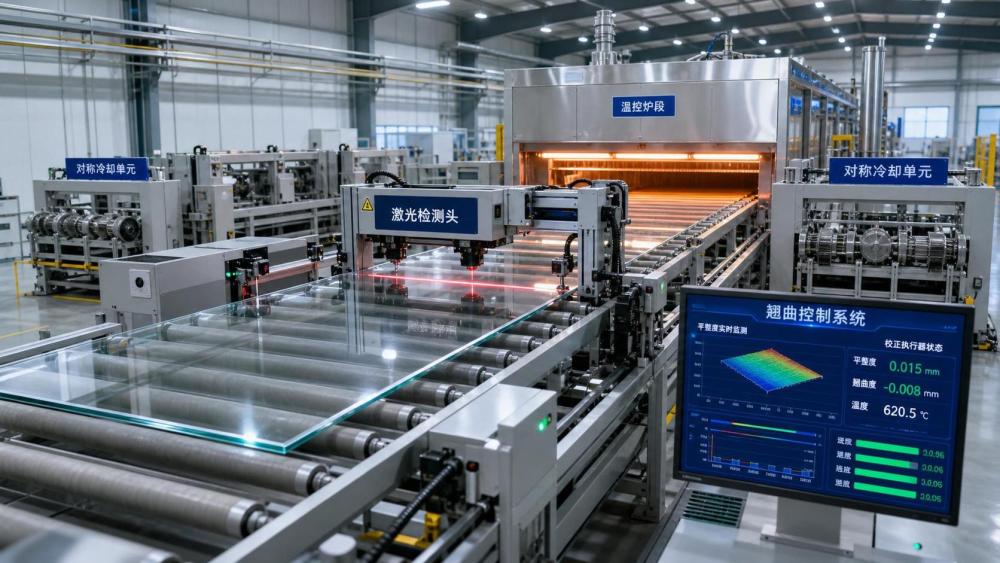
A useful way to view the problem is through process balance. Panels warp when internal forces stop being balanced during heating, forming, quenching, cooling, conveying, or storage. The visible curve is only the final symptom.
In glass lines, uneven temperature profiles often create differential expansion and contraction. In engineered boards or slabs, moisture gradients, resin cure behavior, thickness variation, or support misalignment can trigger the same result.
A warpage control system addresses these interactions as a coordinated process. It does not simply detect bent panels after production. It links thermal behavior, transport stability, process timing, and corrective logic before deformation becomes costly.
This is especially relevant in sectors tracked by NMBS, where production equipment must deliver both mechanical performance and industrial efficiency. Flatness affects not only quality inspection, but also furnace utilization, line synchronization, and final application reliability.
What a warpage control system actually does
At its core, a warpage control system combines measurement, analysis, and adjustment. The exact architecture varies by material and line design, but several functions appear repeatedly in serious industrial setups.
Thermal profile control
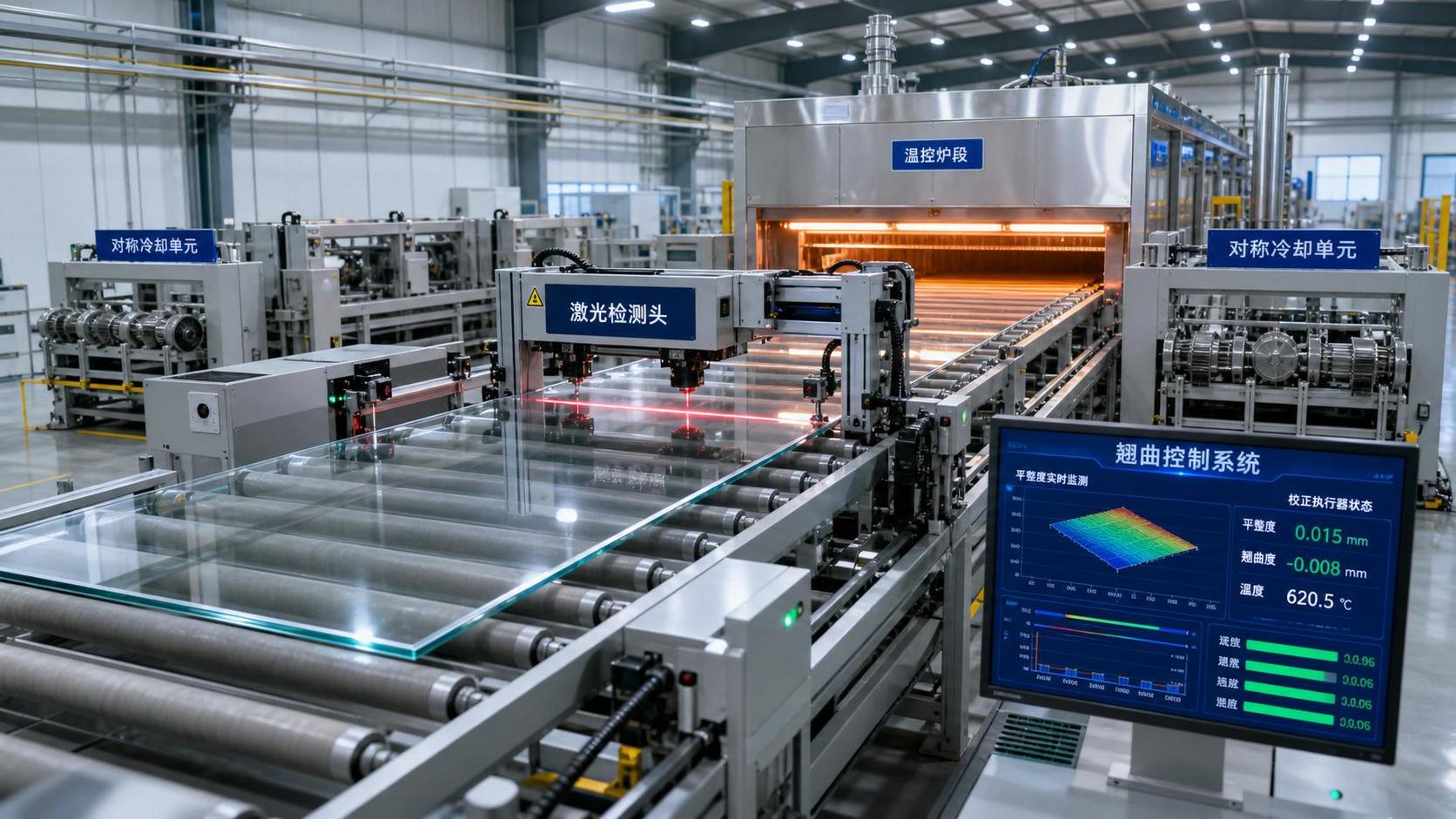
The system tracks heat distribution across the panel surface and through its thickness. It then adjusts heating zones, cooling intensity, air flow, or dwell time to reduce uneven stress buildup.
Real-time shape monitoring
Sensors, laser scanners, machine vision, or displacement devices measure curvature during or after key process stages. This allows the line to identify drift early, not just during final inspection.
Automated correction logic
When shape deviation exceeds the target window, the warpage control system can modify furnace recipes, roller settings, cooling balance, conveyor speed, or support conditions. In advanced lines, these corrections are closed-loop.
Data linking across the line
More mature systems connect flatness data with upstream thickness control, downstream cutting, coating, tempering, or lamination stations. That creates a clearer picture of root cause rather than isolated quality alarms.
Where the performance gains usually appear
The most immediate improvement is higher yield. Fewer panels fall outside flatness tolerance, which reduces scrappage, sorting effort, and unplanned line interruptions. That benefit is easy to understand, but the wider impact is often more valuable.
Stable panel flatness improves process compatibility. Cutting heads remain more accurate. Edge grinding becomes more uniform. Coating and lamination lines run with fewer compensation issues. Packaging and stacking also become safer and more repeatable.
Another gain appears in process confidence. When operators know that a warpage control system is monitoring deformation trends, recipe changes can be tested with less risk. This helps speed up product changeovers and supports broader automation goals.
There is also an energy dimension. Rework, overprocessing, and conservative safety margins consume extra power. Better flatness control often allows narrower process windows without sacrificing quality, which supports lower energy intensity per qualified panel.
Typical scenarios across non-metallic material lines
Although the phrase is common in glass processing, the logic behind a warpage control system applies more broadly. Different materials show different failure patterns, yet the decision framework remains similar.
From an equipment assessment angle, the system should be judged against the actual product family. Thin PV glass, oversized façade panels, and dense engineered slabs do not respond to deformation in the same way.
What deserves closer attention during evaluation
Not every warpage control system delivers the same practical value. Some designs are strong in measurement but weak in correction. Others offer automation features without enough transparency on how flatness data is generated or validated.
A useful evaluation usually starts with four questions.
- How is flatness measured, and at which process stage is the data captured?
- Which parameters can the system adjust automatically, and how fast can it respond?
- Can deformation trends be linked to furnace, conveyor, quench, or upstream material data?
- Is the control model proven for the target panel size, thickness, and production speed?
It is also worth checking whether the line uses static thresholds or adaptive logic. Static alarms may help with rejection control, but adaptive correction is more valuable when product mix changes frequently.
Another practical point is maintenance discipline. If sensors drift, rollers wear unevenly, or thermal zones are not calibrated, even a capable warpage control system will lose credibility. Performance depends on the surrounding process culture.
Why the topic now carries wider business weight
Flatness control is increasingly linked with commercial and regulatory pressure. Large building material lines are expected to run cleaner, faster, and with tighter traceability. Shape stability now influences warranty risk, project acceptance, and equipment bankability.
In sectors such as PV glass and advanced building panels, buyers are no longer comparing equipment only by nominal capacity. They also examine how process systems manage distortion, maintain consistency across batches, and reduce loss under real operating conditions.
That is one reason NMBS places technical attention on process intelligence rather than simple catalog claims. A warpage control system becomes more meaningful when it is understood alongside furnace design, energy behavior, automation architecture, and long-run production economics.
This broader view matters for exporters, EPC planning, and industrial upgrades. A line that controls warpage well is often better positioned for demanding tenders, stricter quality standards, and lower-cost scaling over time.
Turning flatness data into better decisions
The next step is not simply to ask whether a warpage control system is included. The more useful step is to define what flatness performance means for the intended product mix, plant layout, energy target, and downstream process chain.
That usually means building a comparison framework around measurable items:
- allowable bow, wave, and distortion by product type;
- response speed of sensors and correction loops;
- integration with furnace, quench, conveyor, and MES data;
- impact on yield, rework, energy use, and operator intervention.
When those points are clear, equipment comparison becomes more grounded. It is easier to separate genuine process capability from broad performance claims. It also becomes easier to identify where further trials, supplier clarification, or line simulation would add value.
For any operation producing flat rigid panels at industrial scale, the real question is not whether warpage can occur. It is how early it is understood, how precisely it is controlled, and how well the production system turns that control into consistent output.
Related News
- Automatic Hydraulic Press Sizing: Output, Pressure, and Downtime Trade-OffsAuthor :Super-hard Machining Strategist

- Ceramic Press India: How to Compare Capacity, Automation, and ROIAuthor :Super-hard Machining Strategist

- IQSA Issues 2026 Energy Rating Standard for Continuous Panel PressesAuthor :Super-hard Machining Strategist

- Vietnam Tightens Quartz Press Import RequirementsAuthor :Super-hard Machining Strategist

- M6TC Audit Rule Tightens Quartz Press ImportsAuthor :Super-hard Machining Strategist

- Gulf Six Tighten Energy Audit Rule for Quartz Press ImportsAuthor :Super-hard Machining Strategist

- IQSA: Continuous Quartz Press Demand Jumps 42%Author :Super-hard Machining Strategist
![]()
- Ceramic Molding Technology for Tiles: Common Cracking Causes and FixesAuthor :Super-hard Machining Strategist

- Vietnam to Require Local Testing for Quartz Press ImportsAuthor :Super-hard Machining Strategist

- Vietnam Tightens Quartz Press Imports Under QCVN 172:2026Author :Super-hard Machining Strategist

- Vietnam Tightens Testing for Imported Quartz Slab PressesAuthor :Super-hard Machining Strategist

- Vietnam Requires Dual Certification for Quartz Stone Press ImportsAuthor :Super-hard Machining Strategist

- Advanced ceramic body forming: key defects to avoidAuthor :Super-hard Machining Strategist

- US Finalizes China Fiberglass Door Panel DutiesAuthor :Super-hard Machining Strategist

- How to Evaluate a Vibration Compression Press for Stable DensityAuthor :Super-hard Machining Strategist

- How a Warpage Control System Improves Panel FlatnessAuthor :Super-hard Machining Strategist

- EuroBLECH 2026 Highlights Low-Carbon Sheet ProcessingAuthor :Super-hard Machining Strategist