



Search News
Industry Portal
Popular Tags
All categories
Advanced ceramic body forming: key defects to avoid




Advanced ceramic body forming: where do defects start?
Advanced ceramic body forming is often the stage where consistency is decided before firing ever begins. In practice, most visible failures do not start in the kiln; they start earlier, in powder preparation, moisture balance, die filling, pressure control, and equipment stability. For teams responsible for quality and safety, this is the point where small process drift can become cracking, lamination, warpage, density variation, or trapped air.

That is also why advanced ceramic body forming deserves more attention in non-metallic materials production. A stable forming window improves yield, reduces rework, and lowers the chance of downstream issues such as glaze defects, uneven shrinkage, or hidden internal weakness. In NMBS coverage of ceramic and refractory systems, this stage is repeatedly linked with equipment condition, process discipline, and measurable quality control, not just operator experience.
Which defects matter most in body forming?
The most common concern is not one dramatic failure, but a cluster of small defects that later appear as scrap, complaints, or unstable production. Cracking usually points to uneven moisture or stress release. Lamination often signals poor air removal or weak powder layering. Warpage can come from density gradients, while trapped air and local voids reduce strength even when the surface looks normal.
A useful way to judge risk is to ask whether the defect is visible immediately or only after drying and firing. Immediate defects often relate to feeding, pressing, or mold condition. Delayed defects usually point to poor body uniformity that was already built into the compacted part. That distinction matters because the corrective action is different.
A quick defect-to-cause guide
Why does moisture control fail so often?
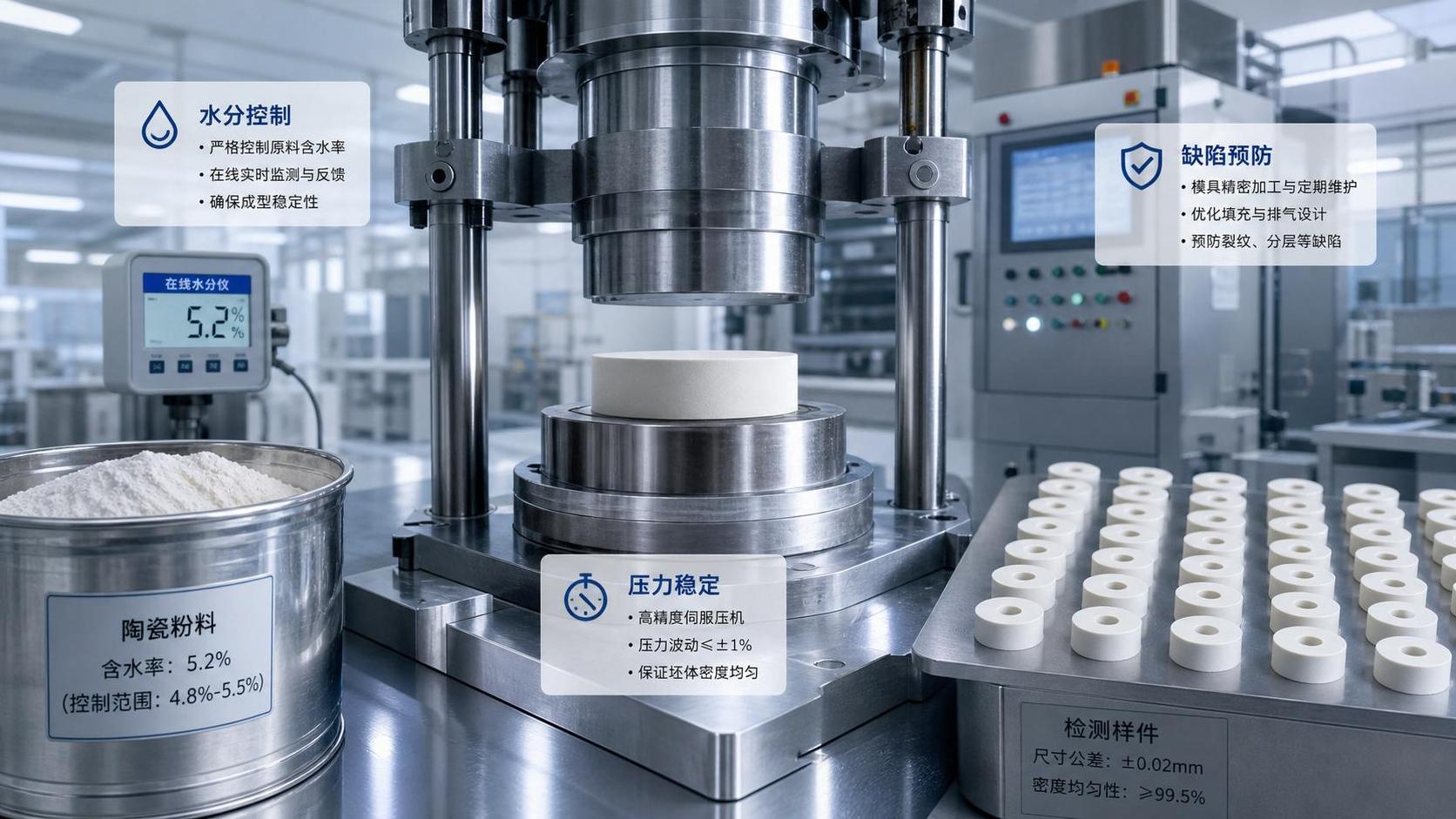
Moisture control sounds simple, but it is one of the easiest places to lose process stability. If the granulate is too dry, it may not compact uniformly and can trap air. If it is too wet, the body may deform, stick to tooling, or create local soft zones that later become cracks or warpage.
The real issue is consistency across the batch, not only the average moisture reading. A line can look stable while one hopper, zone, or time window drifts out of range. In advanced ceramic body forming, that drift often shows up as thickness variation or edge weakness long before anyone notices a major defect.
A practical control method is to link moisture checks with time, temperature, and feed source. When those three points move together, the forming window becomes easier to hold. When they do not, even a well-tuned press can produce inconsistent parts.
How do pressure and mold condition change the result?
Pressure is not just a higher-or-lower setting. It works together with dwell time, release speed, venting, and mold surface condition. Too little pressure leaves porosity and weak bonding. Too much pressure can lock in stress, increase lamination risk, or create uneven density from center to edge.
Mold wear matters just as much. Small gaps, damaged vents, and uneven surfaces interrupt powder flow and air escape. Over time, the defect pattern may shift from random rejects to a repeatable shape or location, which is often a sign that tooling, not raw material, is the main problem.
A good rule is to treat pressure traces and mold inspection records as quality data, not maintenance paperwork. That mindset helps connect forming behavior with later firing performance and supports safer, more predictable production.
What should a control checklist include before firing?
Before the body enters drying or firing, the most useful checks are the ones that reveal hidden non-uniformity. The goal is not to inspect everything; it is to catch the signals that predict trouble. In many plants, that means combining material data, machine data, and visual checks into one routine.
- Confirm granule moisture stays within a narrow band.
- Track filling symmetry and press pressure consistency.
- Inspect mold vents, wear points, and release behavior.
- Review density or weight variation across samples.
- Watch for recurring edge cracks, lifted corners, or soft spots.
This is where advanced ceramic body forming connects directly with quality and safety management. When the body is unstable, downstream operations carry higher risk, more manual handling, and more rework pressure. Good front-end control reduces all three.
How can a plant decide whether the defect is material or equipment-related?
A simple test is repeatability. If the same defect appears across different recipes, shifts, or batches, the equipment or setup is a stronger suspect. If it appears only with one powder source or one moisture condition, the material path deserves more attention.
In real production, the answer is often mixed. Powder segregation, unstable feeding, and worn tooling can reinforce each other. That is why NMBS-style technical intelligence is useful: it helps compare process signals, equipment performance, and production context instead of blaming one variable too early.
For plants working across ceramic, refractory, glass, and other non-metallic systems, this broader view also supports energy and compliance goals. Stable forming reduces waste, and lower waste means lower energy per qualified unit.
What is the most practical next step?
The best next step is to build a short defect map that links each visible problem to its likely process source. Start with the top three rejects, then record moisture, pressure, mold status, and batch timing whenever they occur. Over a few runs, patterns usually become clear.
That approach is more useful than generic inspection alone. It turns advanced ceramic body forming into a controlled process instead of a trial-and-error one. For teams evaluating equipment upgrades or process audits, the key question is not only “what failed,” but “which forming variable moved first?”
If the aim is higher yield and safer operation, focus on moisture uniformity, pressure stability, and tooling condition together. Those three factors usually explain most avoidable defects, and they give the clearest path to more predictable ceramic production.
Related News
- Automatic Hydraulic Press Sizing: Output, Pressure, and Downtime Trade-OffsAuthor :Super-hard Machining Strategist

- Ceramic Press India: How to Compare Capacity, Automation, and ROIAuthor :Super-hard Machining Strategist

- IQSA Issues 2026 Energy Rating Standard for Continuous Panel PressesAuthor :Super-hard Machining Strategist

- Vietnam Tightens Quartz Press Import RequirementsAuthor :Super-hard Machining Strategist

- M6TC Audit Rule Tightens Quartz Press ImportsAuthor :Super-hard Machining Strategist

- Gulf Six Tighten Energy Audit Rule for Quartz Press ImportsAuthor :Super-hard Machining Strategist

- IQSA: Continuous Quartz Press Demand Jumps 42%Author :Super-hard Machining Strategist
![]()
- Ceramic Molding Technology for Tiles: Common Cracking Causes and FixesAuthor :Super-hard Machining Strategist

- Vietnam to Require Local Testing for Quartz Press ImportsAuthor :Super-hard Machining Strategist

- Vietnam Tightens Quartz Press Imports Under QCVN 172:2026Author :Super-hard Machining Strategist

- Vietnam Tightens Testing for Imported Quartz Slab PressesAuthor :Super-hard Machining Strategist

- Vietnam Requires Dual Certification for Quartz Stone Press ImportsAuthor :Super-hard Machining Strategist

- Advanced ceramic body forming: key defects to avoidAuthor :Super-hard Machining Strategist

- US Finalizes China Fiberglass Door Panel DutiesAuthor :Super-hard Machining Strategist

- How to Evaluate a Vibration Compression Press for Stable DensityAuthor :Super-hard Machining Strategist

- How a Warpage Control System Improves Panel FlatnessAuthor :Super-hard Machining Strategist

- EuroBLECH 2026 Highlights Low-Carbon Sheet ProcessingAuthor :Super-hard Machining Strategist