


Search News
Industry Portal
Popular Tags
All categories
How does preheating improve cement kiln energy efficiency?




Preheating improves cement energy efficiency by using hot exhaust gases to warm raw meal before it enters the rotary kiln, reducing the fuel needed to bring the material to clinker-forming temperatures. Multistage cyclone preheaters can recover substantial heat, but their performance depends on gas–solid contact, pressure drop, heat losses and process stability. The best configuration is therefore not simply the one with the most stages: it is the one that reduces total site energy demand without creating problems elsewhere in the line.
Where the heat saving comes from
Clinker production requires raw meal to be heated, decarbonated and then brought to the high temperatures needed for mineral formation. In a dry-process kiln system, much of that preparation can happen before the material reaches the rotary kiln. Instead of allowing hot kiln exhaust to leave the process with most of its useful heat, a preheater transfers part of that energy to the incoming meal.
The result is a smaller heating duty inside the kiln. A precalciner can take the concept further by supplying fuel and combustion air to complete much of the limestone decomposition outside the rotary kiln. The kiln can then focus more of its heat input and residence time on the final reactions and clinker formation.
Preheating and precalcination should not be treated as interchangeable terms. A cyclone preheater recovers heat from the gas stream; a precalciner is a separately fired reaction vessel integrated into the preheater system. Both can reduce the thermal burden on the rotary kiln, but they do so through different mechanisms and involve different fuel, air and control arrangements.
How a cyclone preheater transfers heat
Raw meal enters near the top of the tower and moves downward through a sequence of stages. Hot gases flow in the opposite overall direction, rising from the kiln and, where installed, the calciner. Meal is dispersed into the gas stream, heated rapidly and then separated from the gas in cyclones before passing to the next stage.
Much of the heat exchange takes place while particles are suspended in the connecting ducts, not simply while they are inside the cyclone bodies. That distinction matters when reviewing a supplier design: cyclone separation efficiency is important, but duct geometry, meal distribution and gas velocity also affect heat transfer and wear.
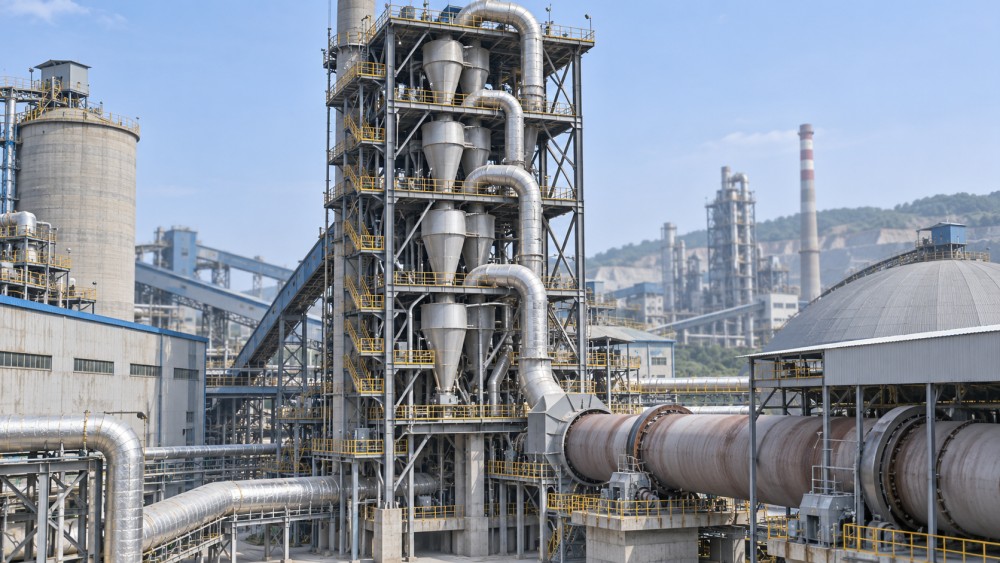
As the meal descends, it meets progressively hotter gas. Moisture is removed, the solids warm up and some decomposition of carbonate minerals begins. In a precalciner system, the calciner supplies additional heat for that reaction before the material enters the kiln. The extent of calcination at kiln inlet is a useful operating indicator, but it must be interpreted alongside kiln stability, fuel use and product quality.
Why more stages are not automatically better
Adding stages generally allows more heat to be recovered from the rising exhaust gas. That can lower the temperature of gas leaving the preheater and reduce specific thermal energy consumption. Yet every additional stage also adds equipment, height, pressure resistance and maintenance obligations. The induced-draft fan may need more power, and the mechanical design may become more demanding.
There is also a site-wide heat balance to consider. Preheater exhaust is commonly used to dry raw materials in the raw mill. If an extra stage cools the exhaust too much, the plant may need another heat source for drying, particularly when incoming materials are wet. A saving at the kiln fuel meter can then be partly offset elsewhere.
The same issue applies when a plant is considering waste heat recovery for power generation. Better internal heat recovery can leave less energy in the exhaust stream for the power system. That does not make the preheater upgrade a poor choice; it means the options should be assessed together rather than assigned independent savings and added up.
A sound comparison starts with actual raw-material moisture, seasonal variation and mill operating hours. Ask what happens during mill-off operation as well as normal production. The exhaust-gas route, conditioning requirements and dust collection conditions can be quite different when the raw mill is unavailable.
Pressure drop, false air and the cost of moving gas
Thermal efficiency is only one side of the calculation. Gas must be pulled through cyclones, ducts, the mill or gas-conditioning system, and the dust collector. Higher pressure drop generally increases fan duty, although the actual electrical penalty also depends on gas flow, fan efficiency and control method.
A low-pressure-drop cyclone can be attractive, but separation efficiency still matters. If more meal escapes with the exhaust gas, dust loading and internal circulation can increase. The right balance depends on the entire gas path, not on a single cyclone’s advertised pressure loss.
False air is another frequent source of misleading comparisons. Air leaking through inspection doors, expansion joints, feed points or rotary valves increases the volume of gas the fan must move. It can also cool the gas and change oxygen readings. A tower may appear to have adequate temperature margins while the fan is consuming unnecessary power and downstream equipment is handling more gas than intended.
Before committing to a major retrofit, measure and repair significant leaks where practical. Otherwise, the projected benefit may partly consist of correcting problems that could have been addressed without replacing the preheater.
Deposits can turn a heat-recovery upgrade into an availability problem
Preheater performance depends on more than clean-design calculations. Volatile constituents, including alkalis, sulfur and chlorides, can circulate within the kiln system and contribute to deposits under unfavorable conditions. Build-up in riser ducts, cyclones or the kiln inlet can restrict flow, disturb temperatures and eventually cause blockages.
The risk changes with raw materials, fuels, operating temperatures and gas chemistry. Alternative fuels can alter the balance, but they should not be assumed to cause a problem without examining their composition and how they are introduced. A bypass may be considered in some systems to control volatile circulation, although it removes hot gas and material from the process and therefore carries an energy and operating cost.
For a retrofit, review deposit history alongside raw-meal and fuel analyses. A proposed stage arrangement that looks favorable on a clean heat balance may be less attractive if it creates difficult access for cleaning or increases exposure to recurring build-up. Availability and safe maintenance access belong in the energy evaluation: a system that saves fuel when clean but repeatedly stops for blockages may not save energy over a full operating period.
What to include in a credible energy comparison
Use a defined operating boundary and compare energy per tonne of clinker, not just fuel per tonne of cement. Cement output can change with the clinker factor and grinding recipe, neither of which proves that the kiln itself has become more efficient. If cement-level performance is relevant, report it separately and explain the product mix.
A practical baseline should cover representative operation rather than a short period chosen for unusually good performance. It should include production rate, fuel consumption and heating-value basis, electrical use of affected fans, raw-material moisture, exhaust conditions, downtime and relevant bypass operation. Record whether the raw mill is running; otherwise, gas temperatures and flows can be difficult to compare.
For the proposed configuration, request a heat and mass balance with the same boundary and assumptions. In particular, check:
- Whether fuel consumption is reported on a consistent lower or higher heating-value basis.
- What gas temperature and flow remain available for raw-material drying, dust collection and any waste heat recovery system.
- How cyclone pressure drops, air leakage and fan efficiency were estimated, including allowances for operating wear and fouling.
- Whether the calculation includes changes in bypass losses, auxiliary fuel, maintenance downtime and clinker production rate.
- Which measurements will be used for acceptance testing and how production conditions will be normalized.
Heat and mass balances are estimates, not guarantees of field performance. Measurement uncertainty matters too: fuel flow and composition, gas leakage, dust return and changing moisture can all affect the result. For formal performance testing or emissions reporting, agree on applicable methods, boundaries and local requirements in the project documents rather than assuming that every supplier uses the same basis.
Fuel savings and carbon reductions are related, but not identical
When a preheater upgrade reduces fuel use, it can reduce combustion-related carbon dioxide emissions. The amount depends on the fuels displaced, their carbon content and the accounting method used. Changes in electricity consumption also matter when assessing the broader emissions effect.
Preheating does not eliminate the process CO₂ released when limestone decomposes during clinker production. Moving more calcination from the kiln to the calciner changes where much of that reaction happens, not the underlying chemistry. Any claim that combines fuel savings, process emissions and indirect electricity emissions should therefore state its boundary clearly.
For an existing line, the most useful next step is often a site heat and mass balance supported by measurements during both mill-on and mill-off operation. Compare stage additions, cyclone upgrades, leak reduction and control improvements against that same baseline. The strongest option may be a smaller intervention that the existing fan, tower and raw-material drying system can accommodate reliably.
Have questions about the global trade trends discussed here, or planning your expansion and supply chain strategy? Leave a message below and let the trade experts at NMBS guide you.
“We respect your privacy. Your information is strictly confidential.”
Related News
- How does preheating improve cement kiln energy efficiency?Author :Powder Comminution Scientist

- China’s Cement and Clinker Exports Rise Sharply in January–September 2026Author :Powder Comminution Scientist

- How to size thermal processing equipment for cement productionAuthor :Powder Comminution Scientist

- How to control rotary kiln dry-out to reduce refractory lining cracksAuthor :Powder Comminution Scientist

- How vibration affects castable refractory molding in rotary kilnsAuthor :Powder Comminution Scientist

- How Do You Calculate ROI for a Cement Waste Heat Recovery Project?Author :Powder Comminution Scientist

- Which kiln upgrades cut fuel use in low-carbon cement production?Author :Powder Comminution Scientist

- When does a cement grinding machine become a bottleneck in clinker outputAuthor :Powder Comminution Scientist

- How to Evaluate Refractory Kiln Technology in ChinaAuthor :Powder Comminution Scientist

- Material Handling Machinery for Cement Plants: What to Check Before SelectionAuthor :Powder Comminution Scientist

- How to Evaluate a Cement Plant EPC Contractor Beyond Bid PriceAuthor :Powder Comminution Scientist

- EPC Cement Plant Risks That Delay Budget and StartupAuthor :Powder Comminution Scientist

- Key Cost Drivers in Cement Plant EPC Projects Before Contract SigningAuthor :Powder Comminution Scientist

- Cement Production Technology: How to Cut Fuel Use Without Process InstabilityAuthor :Powder Comminution Scientist

- Zaozhuang Speeds Export Clearance for Equipment MakersAuthor :Powder Comminution Scientist

- Indonesia Coal Export Shift Pressures Kiln Fuel ChainsAuthor :Powder Comminution Scientist

- OPEC Cuts 2026 Oil Demand View, Easing Kiln Fuel SwingsAuthor :Powder Comminution Scientist

- IMO MEPC 84 Adopts MARPOL Annex VI Amendments Effective September 2027Author :Powder Comminution Scientist

- How to Compare Cement Kiln Systems for Fuel Efficiency and OutputAuthor :Powder Comminution Scientist


