



Search News
Industry Portal
Popular Tags
All categories
Which Automation Upgrades Reduce Cement Grinding Variability?




Cement grinding variability is rarely caused by one unstable machine. It usually emerges from changing clinker hardness, moisture shifts in additives, inconsistent feed proportions, separator drift, worn grinding components, and delayed operator response. The automation upgrades that reduce variability most effectively are therefore the ones that connect measurement, control, and maintenance across the full circuit rather than simply adding more screens to the control room.
The highest-value improvements are typically advanced process control (APC), reliable online material-flow measurement, intelligent proportioning and feeder control, continuous product-quality measurement, and condition monitoring of critical equipment. Their purpose is not to force the mill to run at a fixed load. It is to keep the circuit operating within a stable, economically useful range while raw materials and operating conditions change.
Which automation upgrades have the greatest effect on grinding stability?
For an operating cement mill, the upgrade priority should follow the source of variation. A modern control platform cannot compensate for bad input data, and accurate analyzers cannot stabilize a circuit when feeders are mechanically inconsistent. The most effective package usually starts with dependable field instrumentation and ends with coordinated control logic.
Advanced process control for the grinding circuit
APC is often the most direct automation upgrade for reducing short-term instability in ball-mill and vertical roller mill circuits. Conventional PID loops can hold individual variables around a setpoint, such as mill outlet temperature or separator speed. Their limitation is that grinding circuits are strongly interconnected: a change in separator speed affects circulating load; circulating load affects mill power and material residence time; moisture affects gas demand, drying performance, and grinding behavior.
APC uses process models and multiple operating constraints to coordinate these variables. Depending on the circuit, it may adjust fresh-feed rate, mill ventilation, water injection, grinding pressure, separator speed, fan loading, and sometimes the proportion of corrective materials. Instead of waiting for one variable to exceed a limit, the controller anticipates how a combination of signals is likely to move the process.
In practice, a well-configured APC strategy seeks a stable operating envelope defined by limits such as mill vibration, differential pressure, elevator load, motor current, outlet temperature, and product fineness. It does not eliminate disturbance from a hard clinker lot or wet slag delivery. It reduces the amplitude and duration of the disturbance, preventing repeated manual overcorrection that can create a cycle of overload, underfeeding, and quality drift.
APC is most useful when basic controls, instruments, actuator response, and operating procedures are already reasonably sound. Installing a sophisticated supervisory controller over drifting weigh feeders, plugged pressure taps, or unreliable damper position feedback will not produce dependable results.
Gravimetric feeder modernization and proportioning control
Feed instability is one of the most underestimated causes of cement quality variation. A belt feeder that delivers fluctuating clinker mass flow may still appear acceptable when observed intermittently, yet small deviations in the relative flow of clinker, gypsum, limestone, slag, pozzolan, or other constituents can change mill loading and final cement composition.
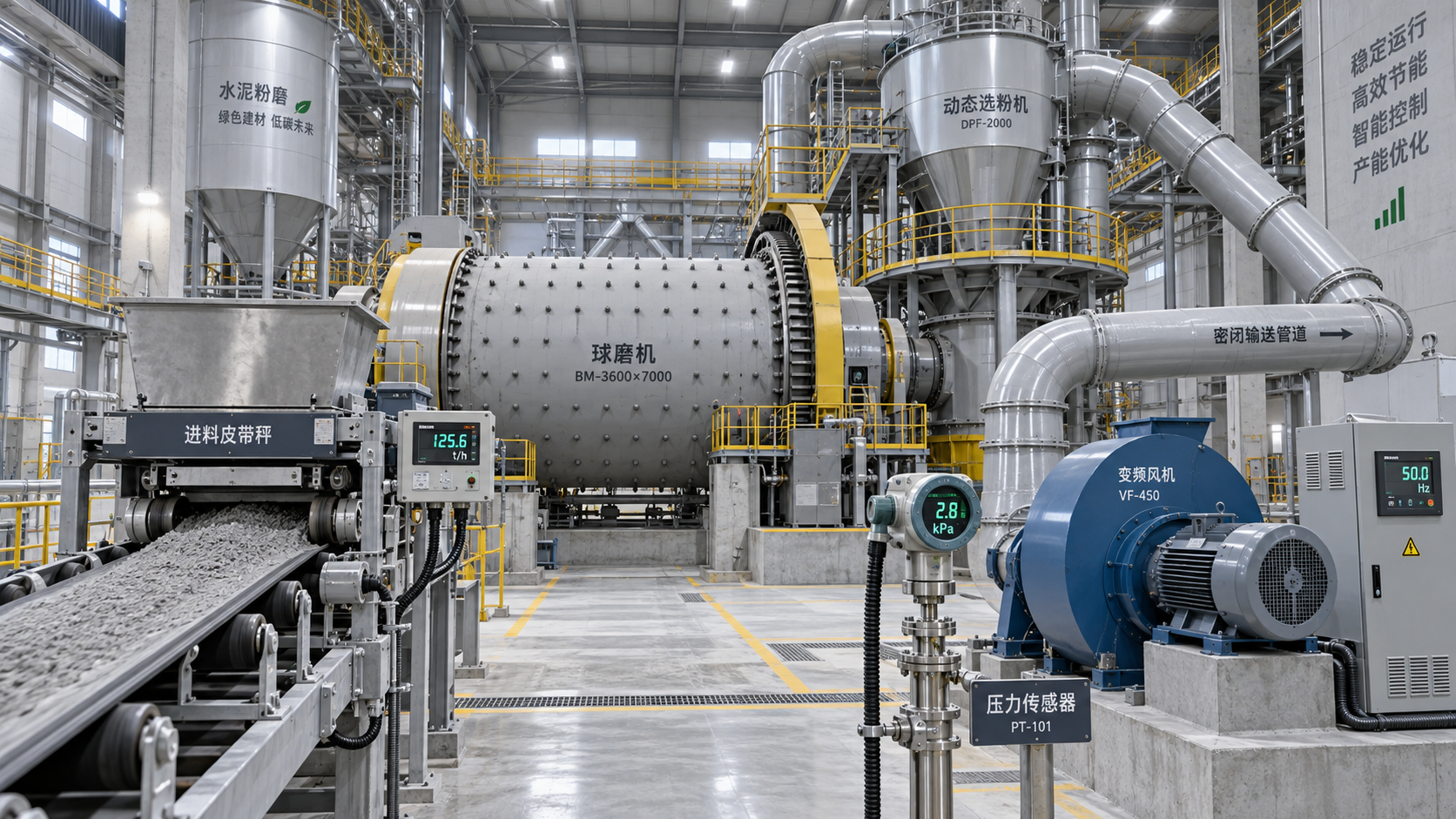
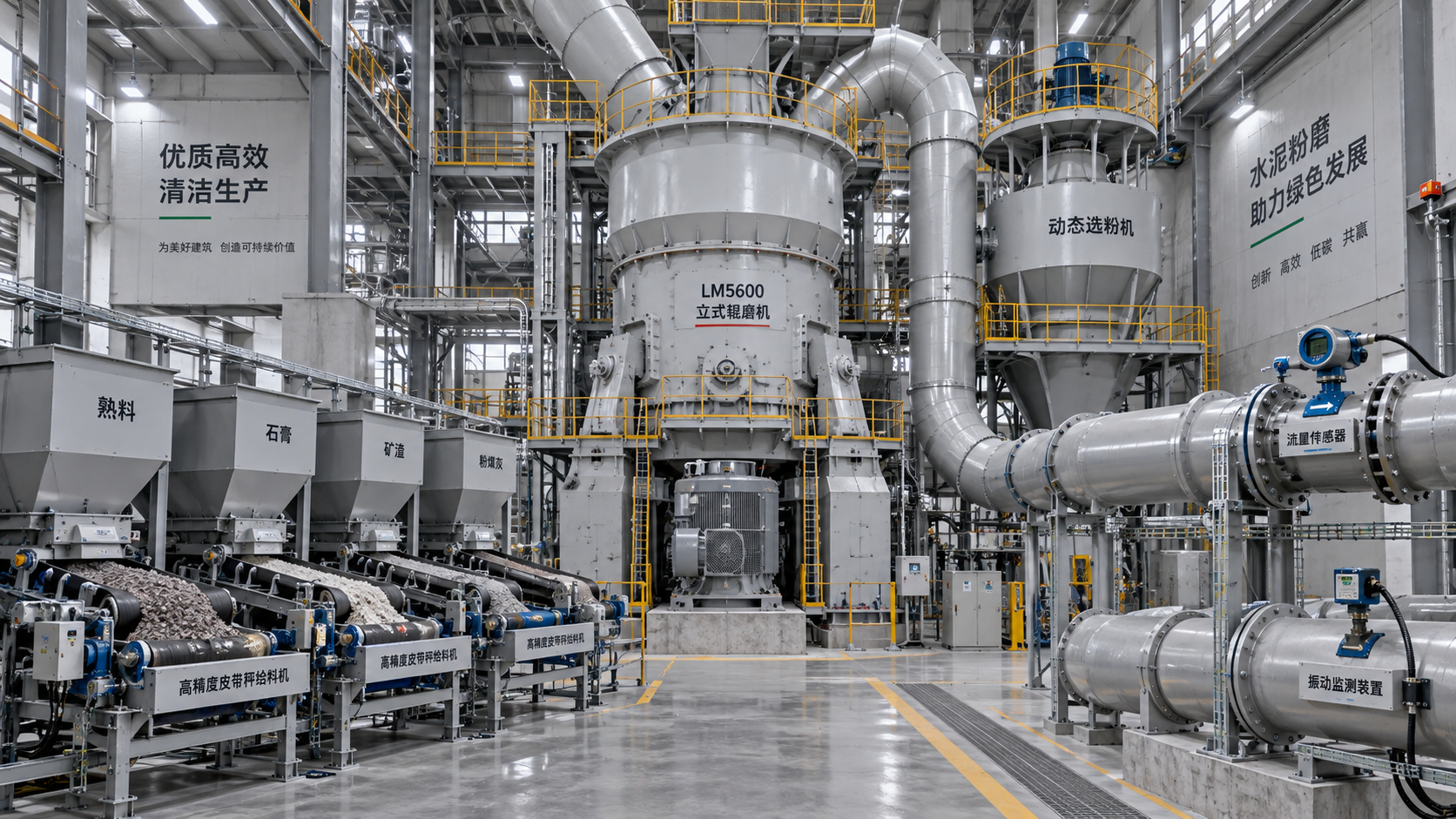
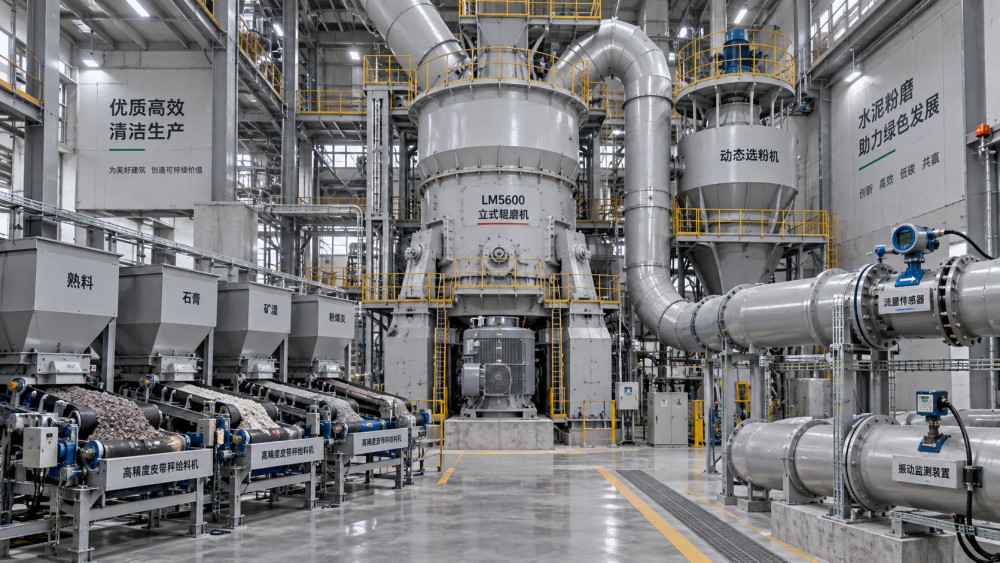
Modern gravimetric feeder systems improve this situation by continuously measuring belt load and belt speed, then correcting feeder output against the required mass-flow setpoint. The useful upgrade is not merely replacing a feeder drive with a variable-frequency drive. It includes calibrated load cells, stable belt tracking, appropriate belt cleaning, accurate speed feedback, and control logic that identifies material-flow loss or abnormal feeder behavior.
Where several constituents are dosed, ratio control should be tied to actual mass flow rather than nominal feeder settings. This is particularly important when supplementary cementitious materials have variable bulk density, moisture, or flowability. A volumetric feeder set to a fixed speed cannot reliably preserve a mass ratio when the material’s physical condition changes.
Intelligent feeder control can also include feed-forward signals. For example, an abrupt increase in wet additive flow can prompt a controlled adjustment in mill feed or gas flow before the mill outlet temperature and differential pressure deteriorate. The value lies in responding to the disturbance at its source rather than correcting its consequences later in the circuit.
Does real-time particle size measurement reduce cement variability?
Yes, provided the measurement is representative, maintained, and linked to a practical control decision. Laboratory Blaine and sieve testing remain important for product release and quality verification, but they are inherently delayed feedback. By the time a sample has been collected, prepared, tested, and reported, a grinding circuit may have processed a substantial quantity of cement under different conditions.
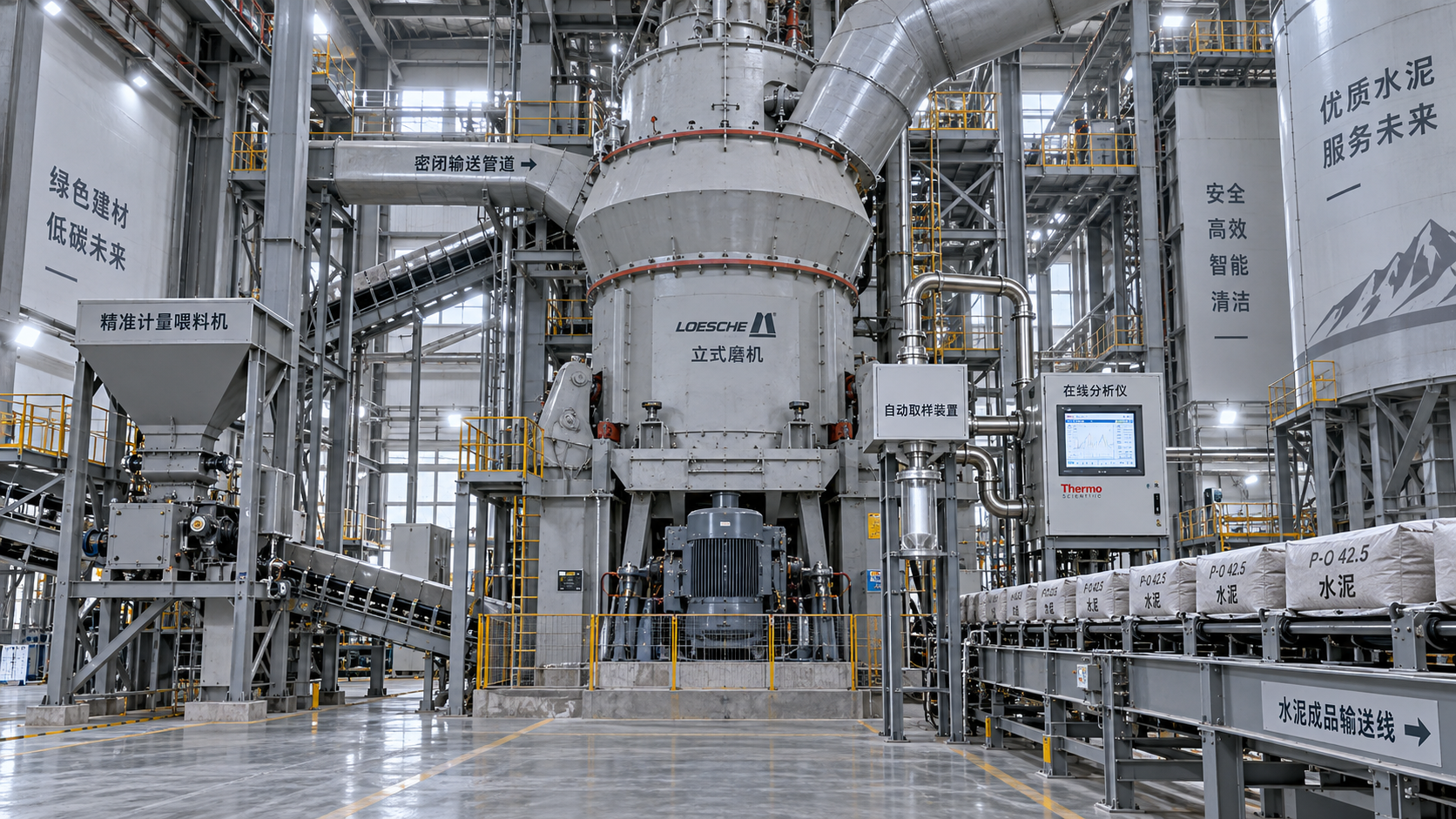
Online particle size analyzers, usually installed on a representative product stream or used with a controlled sampling system, shorten this feedback loop. They can reveal shifts in coarse fraction or particle-size distribution that may not be visible from mill power alone. This is valuable because two products can show similar Blaine values while having different particle-size distributions and potentially different early-strength behavior, water demand, or packing characteristics.
The operational benefit depends on the control objective. In a closed-circuit ball mill, online fineness information can support separator-speed adjustment and help distinguish between insufficient grinding energy and poor classification. In a vertical roller mill, it can assist in balancing grinding pressure, table feed, separator operation, and airflow. The analyzer should not be treated as an isolated quality display. Its readings need to be reconciled with laboratory reference methods and incorporated into control limits that the plant actually uses.
Not every plant requires continuous particle-size analysis as the first investment. If the largest variation comes from feeder inaccuracies or unstable air flow, correcting those foundations may provide greater control value. Online quality measurement becomes especially compelling where several cement types are produced, fineness targets are tight, or rapid changes in raw-material properties create repeated rework and adjustment.
Why are material characterization and feed-forward signals important?
Grinding control is more stable when it knows what is entering the mill. Reactive control relies on observing an effect—rising vibration, declining output, increasing elevator load—after material characteristics have already affected the circuit. Feed-forward control uses upstream information to moderate that effect earlier.
Relevant variables include clinker temperature, moisture in additives, bulk material flow, silo level behavior, and, where the process supports it, composition or hardness indicators. Moisture is particularly influential because it changes material handling, drying demand, and the tendency of fine particles to agglomerate. A sudden shift from dry to damp gypsum or limestone can affect both dosage consistency and grinding efficiency.
Online moisture sensors can help where material moisture varies enough to change process response and where installation conditions permit reliable measurement. Their output is useful only if the control system has a defined action: revising mass-flow correction, modifying hot-gas demand, lowering total feed temporarily, or alerting operations that a stockpile condition has changed.
Clinker grindability is more difficult to measure continuously in a simple way. Nevertheless, production systems can use structured historical data to identify recurring relationships between clinker source, production date, kiln operating conditions, mill response, and required grinding energy. This does not replace laboratory grindability testing, but it can improve operating preparation when known material changes are scheduled.
How do separator and airflow controls affect product consistency?
Classification stability is central to stable cement fineness. In a closed circuit, the separator determines which particles return for additional grinding and which particles become product. If separator speed, airflow, fan performance, or material dispersion varies, the circulating load and particle-size distribution can move even when the mill feed appears constant.
Automation upgrades should therefore include accurate speed control for dynamic separators, reliable measurement of air flow or differential pressure where applicable, damper-position feedback, and condition monitoring for fans and drives. Variable-frequency drives can provide more responsive control than fixed-speed operation with heavily throttled dampers, but they must be selected with the fan curve, system resistance, motor capability, harmonic impact, and process-control requirements in mind.
A common control mistake is to use separator speed as the universal correction for any quality problem. Higher speed generally makes the cut finer, but it can also raise circulating load and push a mill toward instability. If the material is already poorly dispersed or the mill lacks sufficient grinding capacity, increasing separator speed can worsen the problem rather than solve it. APC logic is valuable here because it can evaluate separator action together with mill load, power, ventilation, and product quality.
Can predictive maintenance improve grinding consistency, not just availability?
It can, because gradual mechanical deterioration often appears first as a process-control problem. Worn grinding media, separator rotor wear, roller and table wear, failing bearings, fan imbalance, leaking ducts, and poor actuator response can all change the relationship between a control action and the actual process result.
Condition monitoring provides earlier warning through vibration, temperature, motor electrical signatures, oil condition, pressure trends, and equipment performance data. The objective is not to predict every failure with certainty. It is to identify deviations from normal operating behavior before they produce unstable grinding, unplanned stoppage, or prolonged quality drift.
For a vertical roller mill, vibration trends, hydraulic-system response, gearbox condition, and roller wear can be directly relevant to stable bed formation and mill throughput. For ball mills, bearing condition, drive performance, mill-shell behavior, diaphragm condition, and separator health influence the circuit’s repeatability. Predictive maintenance data should be visible to both maintenance and process teams; separating these systems can obscure the mechanical root cause of an apparent control issue.
What role do operator interfaces and alarm management play?
Automation does not remove the need for operating judgment. It should make that judgment more consistent by presenting the right information at the right level of urgency. Poorly designed human-machine interfaces often encourage operators to react to individual alarms without understanding the process sequence behind them.
A useful interface shows current values alongside trends, target ranges, control-mode status, actuator position, and limiting constraints. It should make clear whether APC is holding the mill at a vibration limit, a separator constraint, a temperature limit, or a quality target. Without this context, manual interventions may conflict with supervisory control and reintroduce variability.
Alarm rationalization is equally important. A grinding-control room flooded with nuisance alarms trains people to ignore alerts. Priority alarms should identify conditions requiring action, while advisory messages can point to developing deviations such as feeder tracking error, analyzer validation drift, abnormal filter differential pressure, or repeated actuator saturation.
Which upgrades should be avoided as isolated “digital” projects?
Several investments are frequently overestimated when deployed without process integration. A dashboard that displays dozens of tags does not improve stability unless it changes how deviations are detected and corrected. Cloud data storage may simplify reporting, but it cannot compensate for missing calibration discipline. Machine-learning tools can help identify patterns in high-quality historical data, yet they are not a substitute for basic mass-flow control, instrument maintenance, or valid process constraints.
Similarly, automatic control of one element can transfer instability elsewhere. Automatically maximizing mill feed without regard to separator load, filter capacity, grinding pressure, or product fineness can increase output variability. The right question is not whether a technology is “smart,” but whether its measurements, manipulated variables, and operating limits are connected to a defined process problem.
How should a plant prioritize an automation upgrade program?
Start by quantifying variability in operational terms: feed-rate swings, product fineness deviation, Blaine variation, separator return instability, specific-energy fluctuation, mill trips, or off-spec recirculation. The selected indicator should match the commercial and technical issue. A plant troubled by inconsistent strength development needs a different diagnostic focus from one constrained by frequent mill overload.
The next step is a control and instrumentation audit. It should examine sensor reliability, calibration records, sampling representativeness, feeder accuracy, control-valve or damper response, drive controllability, network reliability, and data historian quality. This audit often identifies basic improvements that must precede APC or online analytics.
After the foundation is corrected, the most logical sequence is usually to stabilize mass flow and proportioning, improve critical process measurements, implement coordinated circuit control, then add higher-resolution quality monitoring and condition-based maintenance. The exact order changes with the plant’s bottleneck. A mill with volatile additive moisture may need moisture measurement and feed-forward control before online particle sizing. A stable feed system with repeated separator-related quality swings may gain more from classification instrumentation and APC.
The practical test of any upgrade is whether it reduces the time required to return the circuit to stable operation after a known disturbance. Cement grinding will always face variation in materials and equipment condition. Effective automation makes that variation visible earlier, controls it closer to its source, and prevents temporary deviations from becoming persistent quality and energy losses.
Related News
- How grindability affects vertical roller mill sizing for mineralsAuthor :Powder Comminution Scientist

- When does HPGR make sense for mineral crushing equipment upgrades?Author :Powder Comminution Scientist

- Why Does Cement Grinding Output Drop After an Automation Upgrade?Author :Powder Comminution Scientist

- How Often Should Roller Press Wear Parts Be Replaced?Author :Powder Comminution Scientist

- What Should a Cement Plant Material Handling Retrofit Include?Author :Powder Comminution Scientist

- How Can Material Handling Bottlenecks Limit Cement Mill Output?Author :Powder Comminution Scientist

- Which Automation Upgrades Reduce Cement Grinding Variability?Author :Powder Comminution Scientist

- Is Automated Quality Control Worth Adding to an Older Cement Line?Author :Powder Comminution Scientist

- How Should Buyers Compare Cement Grinding Capacity Claims from Suppliers?Author :Powder Comminution Scientist

- What Energy Data Should a Cement Equipment Supplier Provide Before Tender?Author :Powder Comminution Scientist

- When does vertical roller mill grinding outperform ball milling?Author :Powder Comminution Scientist

- How to Choose Cement Grinding Equipment for Slag by Throughput and FinenessAuthor :Powder Comminution Scientist

- Cement Grinding System Selection: Energy Use, Output, and Wear Trade-OffsAuthor :Powder Comminution Scientist

- HPGR Bearing Export Controls TightenAuthor :Powder Comminution Scientist

- HPGR Parts Export Controls Tighten on Bearings and ValvesAuthor :Powder Comminution Scientist

- 7 Ways to Improve Clinker Grinding Efficiency Without Major RetrofitsAuthor :Powder Comminution Scientist

- Vertical Roller Mill for Slag: When Is It the Better Option?Author :Powder Comminution Scientist

- Industrial Crushing Technology Options for Lower Energy Use and Finer OutputAuthor :Powder Comminution Scientist

- Cement Clinker Grinding Equipment: Ball Mill or Roller Press?Author :Powder Comminution Scientist

- Vertical Mill Retrofit Checklist: Capacity Gains vs Downtime RiskAuthor :Powder Comminution Scientist

- Cement Grinding Mill Efficiency: When Upgrades Deliver Real Energy SavingsAuthor :Powder Comminution Scientist

- Industrial Crushing Technology for Limestone: Choosing the Right SetupAuthor :Powder Comminution Scientist

- How to Compare Industrial Crushing Machinery Suppliers on Output and Wear CostsAuthor :Powder Comminution Scientist

- HPGR Energy Limit Tightened to 2.1 kWh/tAuthor :Powder Comminution Scientist

- Cement Grinding Systems: When High-Pressure Roller Mills Outperform Ball MillsAuthor :Powder Comminution Scientist

- Draft Capacity Rules May Delay Export EquipmentAuthor :Powder Comminution Scientist

- Vertical Mill Retrofit: When It Pays Off and What to Upgrade FirstAuthor :Powder Comminution Scientist

- Uzbekistan BIG5 Opens in August as Tax Breaks Support China Building Equipment ExportsAuthor :Powder Comminution Scientist

- China HPGR Exports Rise 35% on Middle East Cement UpgradesAuthor :Powder Comminution Scientist

- EuroBLECH 2026 Puts Hybrid Processing in FocusAuthor :Powder Comminution Scientist

- How to Compare Heavy Duty Crushing Machinery for High-Volume Plant OperationsAuthor :Powder Comminution Scientist

- Indonesia Curbs Nickel, Tightens Tin ExportsAuthor :Powder Comminution Scientist

- Dry High-Capacity Grinding Technology: When It Beats Ball Milling on Throughput and EnergyAuthor :Powder Comminution Scientist

- PPI Signal: HPGR Input Costs Up, Lead Times Reach 14 WeeksAuthor :Powder Comminution Scientist

- China’s HPGR Exports Jump 41% in Q1 as Southeast Asia Leads DemandAuthor :Powder Comminution Scientist

- When Vertical Roller Mills Beat Ball Mills on Power and FootprintAuthor :Powder Comminution Scientist