



Search News
Industry Portal
Popular Tags
All categories
China Tightens Vacuum Extruder Export Filing Rules




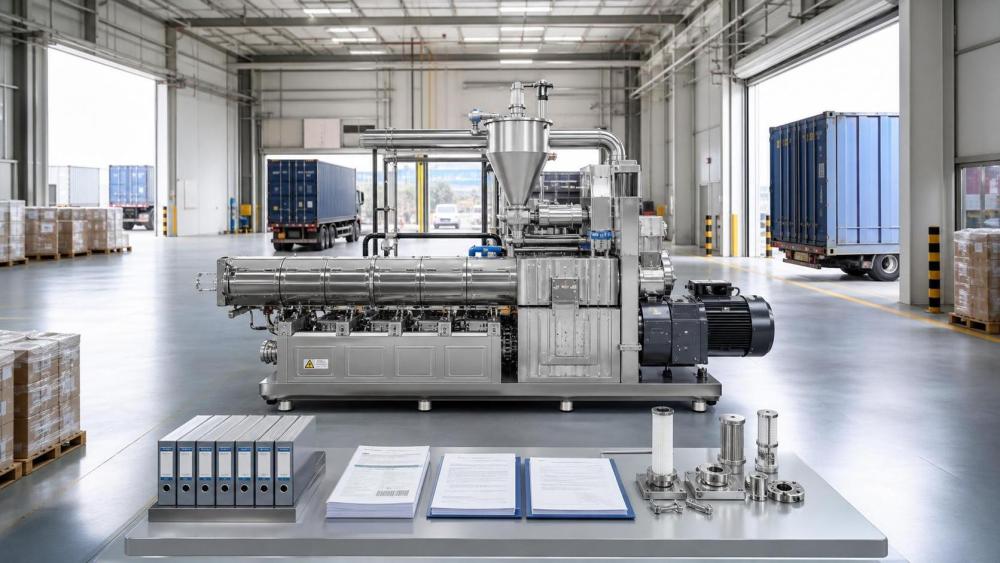
Effective August 15, 2026, China’s customs authorities will require exporters of vacuum extruders to submit a dust emission test report that complies with ISO 16000-33:2026 as part of export declaration filings. The change links environmental compliance documents directly to customs clearance, which makes it immediately relevant for equipment manufacturers, exporters, testing-related service providers, procurement teams, and delivery planning functions because documentation readiness may now affect shipment timing as much as production readiness.
A new document requirement now sits inside export clearance
According to the provided event summary, the General Administration of Customs of China issued the Notice on Strengthening Environmental Compliance Management for the Export of Non-metal Material Forming Equipment on July 7, 2026, under reference number 署监发〔2026〕78号. From August 15, 2026, all export customs declarations for Vacuum Extruders must be accompanied by a dust emission test report issued by a CNAS-accredited laboratory and compliant with ISO 16000-33:2026.
The required report must include three core indicators: particulate concentration, particle size distribution D50, and filter media penetration rate. The requirement applies to all export destinations. The provided summary also states that the change directly affects delivery schedules and document preparation cycles.
Where the immediate pressure is likely to appear
Export shipment preparation may become more document-driven
From an industry perspective, exporters of vacuum extruders are likely to feel the most direct impact because the filing requirement is tied to customs declaration itself. That means the relevant compliance report is no longer a peripheral technical file; it becomes part of the shipment readiness package. What deserves closer attention is whether internal export workflows, document review steps, and booking schedules are aligned with the new submission requirement before the August 15 effective date.
Manufacturing and delivery planning may face tighter sequencing
For manufacturers, the main issue is not only product completion but the sequencing between testing, report issuance, and shipment release. Analysis shows that when a required report is connected to export filing, production completion alone may no longer be enough to protect delivery commitments. Teams responsible for dispatch planning, factory release, and contract delivery dates should therefore pay closer attention to how the testing document is incorporated into outbound milestones.
Testing and compliance support functions may move closer to the transaction front end
Observably, laboratories and compliance support teams are affected because the rule specifies both the report standard and the accreditation condition. The practical shift is that testing-related coordination may need to start earlier in the export process rather than after commercial arrangements are already fixed. For traders, documentation service providers, and compliance coordinators, the key concern is whether report scope, format, and timing are adequate for customs filing needs.
Buyers and procurement teams may need to review document clauses
Procurement and sourcing teams connected to vacuum extruder exports may also be affected, especially where shipment timing, technical documentation, or acceptance files are written into contracts or bid packages. It is more appropriate to understand this as a signal to review whether requested delivery dates and document lists reflect the added testing requirement, particularly when export schedules are tight and customs documentation is prepared close to shipment.
What companies should review now
Check whether compliance review already covers the new filing document
Analysis shows that companies should first confirm whether their current export compliance checklist for vacuum extruders includes a CNAS-accredited laboratory report compliant with ISO 16000-33:2026. The key point is not only having a test record, but having the exact type of report described in the provided summary and ensuring that the three stated indicators are covered in the submission materials.
Revisit lead times for testing, paperwork, and dispatch
What deserves closer attention is the interaction between testing lead time and shipment lead time. The provided information already indicates a direct effect on delivery and document preparation cycles, so exporters and operations teams should examine whether existing dispatch promises, booking windows, and handover dates leave enough room for report preparation before customs declaration.
Watch for execution wording and documentary expectations
Because the provided input does not include detailed implementation instructions beyond the core requirement, it would be premature to describe any settled execution outcome. Observably, companies should continue monitoring how the requirement is referenced in practice through customs-facing documentation workflows, internal compliance reviews, and transaction documents that depend on export timing.
Review technical and commercial files together
From an industry perspective, this is also a document coordination issue. Enterprises should examine whether technical files, export declaration packages, contract appendices, and any procurement or tender-related documentation are consistent with the new requirement. The main concern is avoiding a situation in which the product is ready but the supporting file set is incomplete for filing purposes.
How this development is best understood at this stage
Analysis shows that this is more than a general policy signal because the provided summary includes a clear effective date, a named regulatory notice, a defined product scope, a specified report standard, and identified technical indicators. At the same time, it is still necessary to observe how the requirement is executed in day-to-day filing practice, especially in relation to documentation review, timing expectations, and how consistently market participants adapt their internal processes.
It is more appropriate to understand this as an implemented compliance change with practical execution implications, rather than as a broad market trend statement. The part that still requires observation is not whether the rule exists, but how its documentary and operational consequences are reflected in export workflows and related commercial arrangements.
A compliance signal with immediate operational consequences
For the vacuum extruder segment, the significance of this update lies in the fact that environmental testing documentation is now directly connected to export declaration readiness. That creates a concrete compliance checkpoint in the shipment process. A neutral reading is that the rule should currently be treated as an active filing requirement with direct implications for paperwork sequencing and delivery preparation, while the finer points of market execution still merit continued observation.
Basis of this article
This article is generated from the user-provided news title, event date, and event summary. For developments of this kind, relevant source categories commonly include official notices, releases from regulatory authorities, customs or trade administration updates, industry association communications, standard-setting organization documents, and reporting by authoritative trade media. A specific official source link was not provided in the input, so it still needs to be verified on an ongoing basis. Further observation is also needed regarding implementation details, compliance interpretation, tender document updates, industry feedback, and how companies carry the requirement into actual export operations.
Related News
- Ceramic Body Forming Equipment for Stable Density and Fewer DefectsAuthor :Masonry Automation Architect

- China Tightens Vacuum Extruder Export Filing RulesAuthor :Masonry Automation Architect

- China Customs Adds Dust Test Filing for Vacuum ExtrudersAuthor :Masonry Automation Architect

- Vietnam Tightens Dust-Test Rules for Imported ExtrudersAuthor :Masonry Automation Architect
![]()
- Vacuum Extrusion Technology for Bricks: Key Quality Control PointsAuthor :Masonry Automation Architect

- How to Evaluate Ceramic Body Forming Equipment for Stable OutputAuthor :Masonry Automation Architect

- Vacuum Extrusion Technology for Ceramics: Key Quality Control PointsAuthor :Masonry Automation Architect

- Indonesia Extends Ore Curbs to Cobalt and TinAuthor :Masonry Automation Architect