



Search News
Industry Portal
Popular Tags
All categories
How smart manufacturing can reduce defects in concrete blocks




Smart manufacturing can reduce defects in concrete blocks by detecting process drift before it becomes a batch of cracked, undersized, or low-strength products. The most effective controls connect aggregate moisture, material dosing, mold filling, compaction, curing, and handling to measurable quality outcomes. Automated inspection alone catches defects after they occur; connected process control can help prevent them.
That distinction matters because a block can look acceptable while failing strength requirements, and a chipped edge does not necessarily indicate a mix-design problem. Reliable improvement depends on tracing each defect to its production conditions, validating corrective actions, and retaining physical testing as the basis for product release.
Match the defect to the process that created it
For dry-cast, vibropressed concrete blocks, quality develops across several linked operations. A moisture deviation changes how the mix fills and compacts. Compaction affects green strength and dimensions. Curing influences strength development, while transfer and stacking can damage otherwise acceptable units. These controls are not directly interchangeable with those used for autoclaved aerated concrete or wet-cast products.
A useful starting point is a defect map that links observations to plausible causes and the measurements needed to distinguish them.
These relationships are diagnostic leads, not automatic conclusions. Repeated corner damage in one mold cavity suggests a different investigation from damage appearing across every cavity after a conveyor transfer. Inspection at both locations helps separate forming defects from handling defects.
Control moisture before changing the recipe
Aggregate moisture is a high-value control point because it affects both the water entering the mixer and the dry aggregate mass delivered by weight. If wet aggregate is treated as dry material, a nominally correct batch can contain too much water and too little aggregate solids.
Moisture sensors can support automatic corrections to aggregate dosing and added water. However, their readings need calibration against reference measurements for the actual material, installation position, and operating conditions. A sensor calibrated for one sand source should not be assumed accurate after a significant change in mineral composition or grading.
The correction also needs to distinguish total aggregate moisture from water absorbed within the particles. Water available to the cement paste cannot be determined reliably from an unqualified moisture percentage. The batching calculation should use a defined moisture basis, measured absorption values, and a validated material balance.
In dry-cast production, workability is not adequately described by a conventional slump check. The mix must distribute through the mold, compact consistently, and retain its shape immediately after demolding. Too little available water can impair compaction and hydration; too much can cause sticking, deformation, and unstable demolding. The acceptable operating window must be established for each product and mix rather than copied from another line.
Moisture correction cannot compensate for every raw-material change. A shift in particle grading or fines content can alter packing and water demand even when measured moisture is stable. Incoming-material checks therefore remain necessary alongside online sensing.
Make batching errors visible at the point of production
Automated batching reduces defects only when it verifies actual delivery rather than simply executing a recipe. The production record should retain target and actual weights, moisture corrections, admixture delivery, mixing time, material identity, and recipe version. A completed dosing command is not proof that the correct quantity entered the mixer.
Load-cell calibration, scale zero checks, feeder cutoff behavior, and material buildup all affect dosing accuracy. These faults can produce a systematic error across many batches while the control screen continues to show normal operation.
Alarm limits should reflect the sensitivity of the material and the capability of the dosing equipment. Applying one percentage tolerance to cement, aggregate, water, and low-dose admixtures can obscure important errors. Out-of-tolerance batches need a defined response: hold, review, validated correction, or rejection. Silent operator overrides undermine both prevention and traceability.
Mixer power or torque trends can provide supporting evidence of a change in consistency, but they are indirect measurements. Mixer wear, batch size, and material distribution also influence the signal. Such trends are most useful when compared with moisture checks and product results, not treated as stand-alone proof of mix quality.
Monitor filling and compaction, not just cycle time
A machine can complete every cycle on schedule while producing unevenly compacted blocks. Cycle time indicates throughput, not necessarily whether material was distributed and consolidated correctly.
Useful measurements include mold-fill consistency, tamper position, vibration behavior, hydraulic pressure where relevant, and green-block height. Accelerometers can help identify changes in machine vibration, but interpretation depends on sensor location, mounting, machine condition, and the relationship between the measured signal and actual product consolidation.
Block mass is another practical indicator. For a fixed product geometry and stable mix, a sustained mass shift can flag changes in filling or compaction. Mass should be assessed alongside dimensions: a heavier block is not automatically a better block, and an apparent density calculation can be misleading if geometry changes.
Cavity-level records are particularly useful. If defects repeatedly concentrate in one position, averaging measurements across the whole pallet can conceal the problem. Mold wear, feed distribution, tamper alignment, and pallet support should then be checked before changing the entire mix.
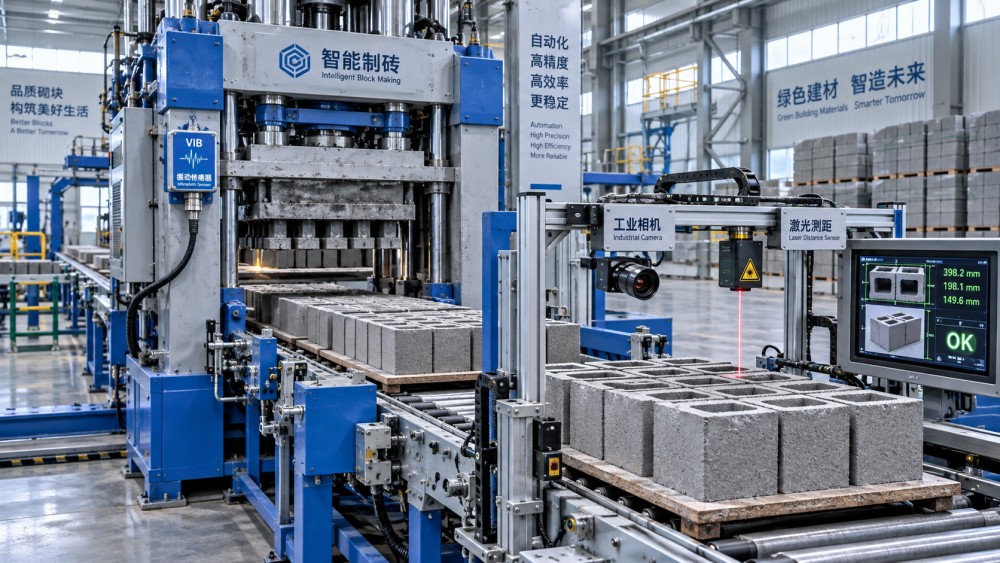
Closed-loop adjustment should follow controlled trials. Automatically increasing vibration whenever height moves outside a target may worsen segregation, tooling stress, or another defect. Safe adjustment ranges must be established for the machine and product, with clear limits on what the system may change without approval.
Treat curing as a controlled production stage
Consistent forming does not guarantee consistent strength if curing conditions vary. Temperature, humidity, exposure duration, and air circulation influence hydration and drying. A sensor near the chamber entrance cannot establish that every rack experiences the same environment.
Curing control begins with mapping conditions at representative locations under actual loading arrangements. Sensors should capture meaningful differences between zones, with calibration and placement that account for condensation, contamination, and maintenance access. The resulting record should follow the pallet or rack through its curing cycle.
Temperature ramps and moisture conditions must suit the cementitious system and product. Aggressive heating is not a universal shortcut to release strength: excessive gradients or poorly controlled drying can introduce damage. A changed cement source or supplementary cementitious material content may also require the curing cycle to be revalidated.
Maturity-based estimates can support decisions where a mix-specific strength relationship has been established. They should not replace required acceptance testing without an approved basis. A temperature history alone cannot demonstrate that dosing, compaction, and moisture were correct.
Transfer, stacking, and dispatch decisions should therefore use validated release criteria. Elapsed curing time is insufficient when the recorded conditions differ from those used to establish the release rule.
Use vision inspection without confusing appearance with compliance
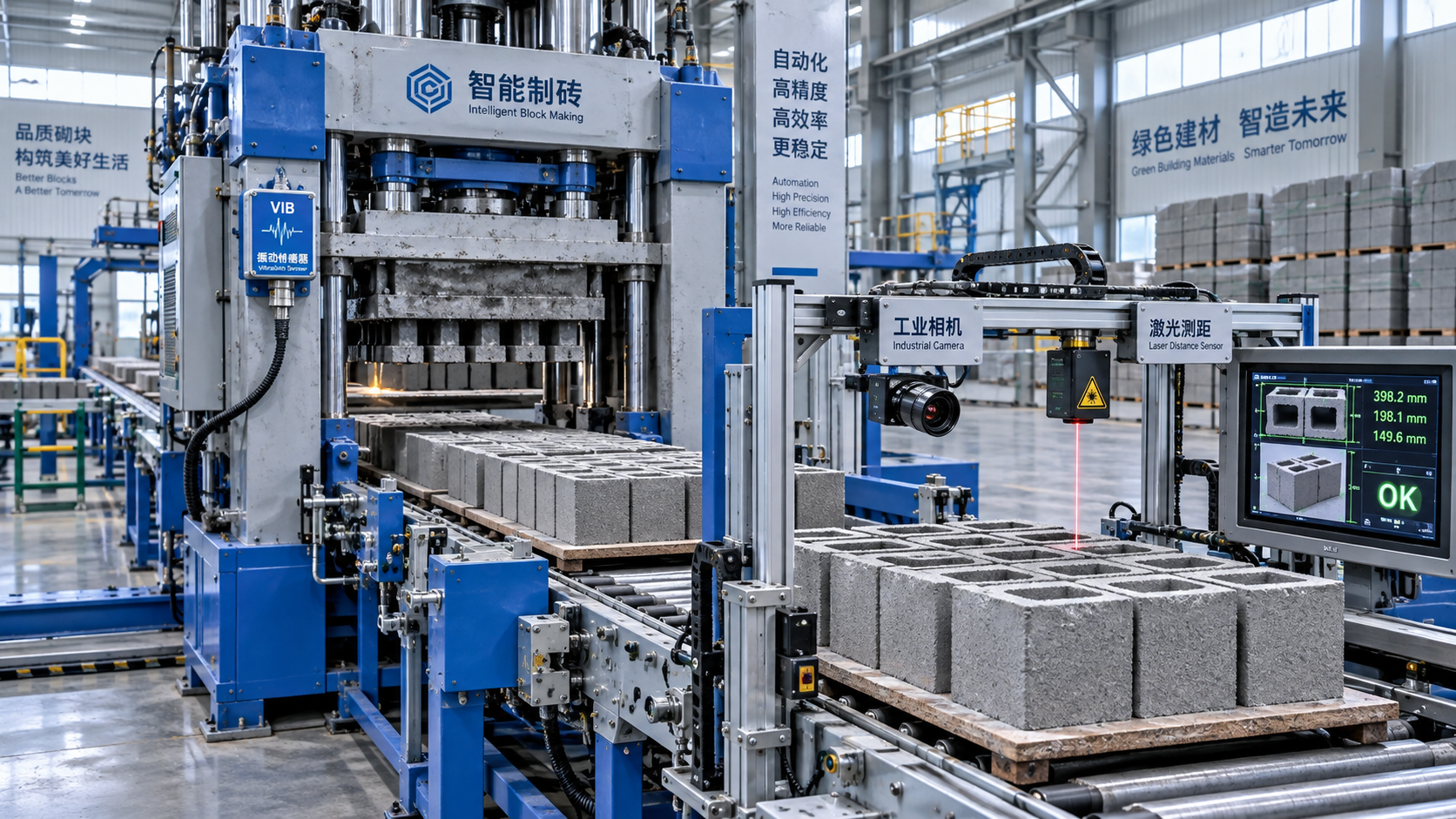
Machine vision can screen for edge damage, visible cracks, surface defects, and dimensional deviations. Its value depends on controlled lighting, adequate camera resolution, repeatable positioning, and access to the surfaces where defects occur. Dust, wet surfaces, shadows, and normal texture variation can all affect detection.
The inspection system needs explicit defect definitions and acceptance boundaries. It should be challenged with representative acceptable and defective blocks, including different colors, textures, and damage sizes. Both missed defects and false rejects matter: the former allow unsuitable products through, while the latter waste material and encourage operators to bypass the system.
External images cannot reliably establish internal integrity, compressive strength, or absorption. Vision screening must complement laboratory and dimensional testing under the applicable specification. For example, ASTM C90 addresses loadbearing concrete masonry units, while ASTM C140/C140M provides sampling and testing methods for concrete masonry units and related units. EN 771-3 covers aggregate concrete masonry units. The applicable standard, edition, product category, and contractual requirements must be confirmed for the intended market.
Turn traceability into a containment tool
A useful digital record connects material lots, batch data, machine settings, mold identity, pallet or rack identification, curing history, inspection results, and laboratory samples. The essential question is whether a failed test can be traced back to the affected production—and whether neighboring production can be assessed for the same exposure.
Where individual block identification is impractical, traceability can operate at pallet, rack, batch, or defined production-interval level. That resolution determines how narrowly a suspect lot can be contained. Fine-grained process data provide little benefit if pallets lose their identity during curing or stacking.
Control limits and specification limits serve different purposes. A statistical signal can reveal process drift while products still meet specifications; a stable process can nevertheless produce nonconforming units. Trending block height, mass, defect location, and strength variability helps distinguish these situations.
When a critical deviation occurs, the system should record the last verified acceptable production point, identify the potentially affected lot, and prevent unauthorized release. Missing or unreliable data also need a defined response rather than an assumption that production remained acceptable.
Keep automatic quality corrections within safety boundaries
Quality automation must not override machinery safeguards. Changes to vibration, pressing, feed motion, transfer timing, or robotic handling can alter mechanical and personnel hazards. These adjustments require an approved operating envelope and a separate safety assessment.
Remote access, sensor maintenance, camera cleaning, and interventions around blocked conveyors introduce additional exposure points. Guarding, safety-rated interlocks where required, and isolation procedures must remain effective independently of ordinary process-control software. A dashboard command to stop production is not a substitute for verified energy isolation.
Handling damage deserves particular attention because it can create both rejects and unstable loads. Transfer alignment, acceleration, gripper condition, pallet integrity, and stacking patterns should be linked to damage records. Reducing speed without locating the impact point may leave the underlying hazard unresolved.
Validate one defect-reduction loop before scaling
A practical deployment starts with a significant, measurable defect rather than a plant-wide collection of sensors. Establish the baseline by product, shift, mold, and defect location; confirm that the measurement system can distinguish meaningful variation; then connect the suspected process variables to the affected production.
For example, edge-breakage reduction may require moisture measurement, compaction monitoring, and inspections before and after transfer. If blocks are intact immediately after demolding but damaged downstream, the evidence directs corrective work toward handling rather than a recipe change.
Validation should compare reject rate, strength variability, dimensional consistency, false-reject frequency, and handling damage across representative operating conditions. Product type, raw materials, tooling condition, and curing arrangements must be accounted for so their effects are not mistaken for an automation benefit.
Smart manufacturing building materials solutions deliver useful defect reduction when measurement leads to a verified corrective action. The decisive capability is not the volume of data collected, but whether the production team can identify a deviation, contain affected blocks, correct its cause, and demonstrate that the process has returned to an acceptable condition.
Related News
- How smart manufacturing can reduce defects in concrete blocksAuthor :Masonry Automation Architect

- How to size precast concrete equipment for planned daily outputAuthor :Masonry Automation Architect

- How production output affects the cost of a paver block machineAuthor :Masonry Automation Architect

- How to Evaluate a Brick and Block System Manufacturer for Output, Automation, and Lifecycle CostAuthor :Masonry Automation Architect

- How to Choose a Concrete Block Machine Based on Output, Mold Change Time, and Pallet SizeAuthor :Masonry Automation Architect

- Brick and Block Machine Manufacturer Checklist for Plant InvestmentAuthor :Masonry Automation Architect

- How High-Performance Concrete Technology Extends Bridge Service LifeAuthor :Masonry Automation Architect

- Fly Ash Brick Production Process: Key Steps and Quality RisksAuthor :Masonry Automation Architect

- Fly Ash Brick Production Cost: What Shapes ROI Beyond Equipment PriceAuthor :Masonry Automation Architect

- Precast Concrete Machinery: Downtime Risks Hidden in Mold ChangeoversAuthor :Masonry Automation Architect